


mail@facirus.ru


 Automatic pellet boilers
 Automatic wood chip boilers
 Two-pass gas boilers
 Three-pass gas boilers
 Automatic coal boilers
 Manual solid fuel boilers(coal/firewood/briquettes)
 Semi-automatic boilers(coal/firewood/briquettes)
 Outdoor hoppers and fuel stores
 Solid fuel block-modular boiler houses
 Block-modular boiler houses for liquid and gaseous fuels
 Hot air generators
 Pellet stoves

Heating a greenhouse with a pellet boiler. What to heat a greenhouse with and why choose FACI?
A greenhouse, as a heated hothouse, is a protective structure for growing plants in various climatic conditions. A greenhouse can be small or industrial in scale - covering up to a dozen hectares.
What to heat a greenhouse with?
The most common and widely available fuel for heating greenhouses is firewood. Firewood is burned in small stoves installed inside the greenhouse or in solid fuel boilers.
This relatively cheap fuel causes a lot of trouble and requires constant human presence, especially at night. The risks associated with the human factor are high: a greenhouse left without heat will cool down to the outside air temperature in a couple of night hours.
When it comes to industrial greenhouse complexes, excessive savings on heating can lead to the loss of the crop and with it the loss of profit.
Autonomous operation is only possible if fuel is supplied automatically in the required amount and the set temperature is maintained in the greenhouse. Only modern automatic boilers running on fine coal and pellets can handle this task. The autonomous operating time of such boilers depends only on the size of the fuel hopper.

Let's look at one of the sites located in Ipatovo, Stavropol Territory, as an example.
A farmer who had received a state grant for agricultural development approached our company TeploTrend with a request to heat a farm greenhouse with a total area of 1300 m² and a ridge height of 4.5 metres. Fruit vegetables and greens are to be grown: tomatoes, cucumbers, onions.
The following parameters were taken into account when selecting the boiler output:
- Required greenhouse temperature +24 °C
- Outdoor temperature -19 °C
- Covering: Italian double film 180 µm.
The calculated peak heat load at night at an outdoor temperature of -19 °C is 246 kW.
To provide the greenhouse with heating and long autonomous operation, it was proposed to install two FACI Classico 130 pellet boilers connected in cascade.
This connection scheme has a number of advantages:
- if one of the boilers fails, the system will keep working and heating the site;
- fuel savings: on the warm days of the season only one boiler is used, which reduces the efficiency loss of running both boilers at partial output;
- the ability to service a boiler without stopping the entire heating system.
Why FACI?
- Retort burner. A feature of this type of burner is that it is "omnivorous", i.e. able to run on fuel of different types and qualities. Since heating costs are the second largest expense item directly affecting the cost of the product, cheap fuel is needed.
- Fuel feed safety. In the event of an emergency shutdown or a jammed fuel feed, the twin-auger mechanism prevents a fire in the hopper.
- Boiler control system. The modern multifunctional control panel allows the boiler operation to be monitored remotely. The smartphone app lets you switch the boiler on or off, set the required temperature and, most importantly, receive alerts about any faults.
A number of advantages combined with the reliability of the equipment set FACI boilers apart from their competitors.
The site was put into operation in November 2021.
Fuel used - agro-pellets made from sunflower husks.
The greenhouse is heated by air - using 12 GREERS water fan heaters.
Is it profitable to heat with pellets?
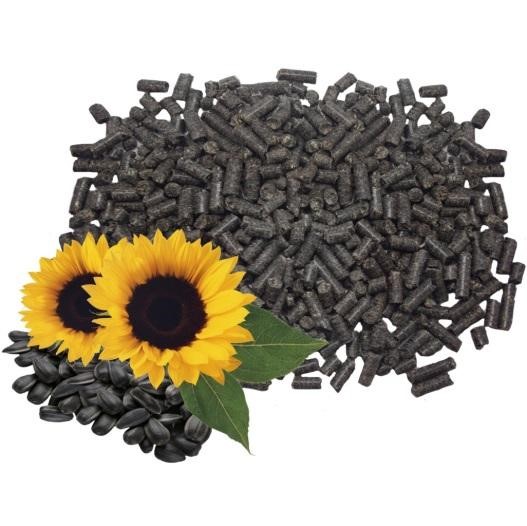
Sunflower husk pellets are made from waste left after the vegetable oil production cycle.
The main advantages of sunflower husk pellets over other fuels:
 |
|
Pellet consumption per 1 kW of heat:
Average energy value in operation: 18.55 MJ/kg / 3.6 MJ = 5.15 kWh
So by burning 1 kg of pellets we get 5.15 kWh of energy, which means that to get 1 kW of output we need to burn 1 kg / 5.15 kWh = 0.19 kg of sunflower husk pellets.
With our two boilers of 130 kW each, the consumption of each at rated output will be: 130 * 0.19 / 0.9 (boiler efficiency) = 27.4 kg per hour.
On average, the boiler in a greenhouse runs 12-16 hours a day; exactly how long depends on the heat losses and maximum winter temperatures in the particular region.
How much does it cost to heat a greenhouse in the South:
The average price of sunflower husk pellets in 2021-2022 was RUB 7 per kg.
A 130 kW FACI pellet boiler consuming 27.4 kg/h * RUB 7 = RUB 192/h
With two boilers running at the same time, RUB 192/h * 2 = RUB 384/h
With the boilers running an average of 12 hours a day * RUB 384/h = RUB 4,608.
At this site, consumption over the heating season from mid-December 2021 to March 2022 was about 53 tonnes; for most of the winter one boiler was enough.
53,000 kg * RUB 7 per kg = RUB 371,000 per season.
Delivery to the site and commissioning were carried out by the official dealer in Southern Russia, TeploTrend.
TeploTrend (individual entrepreneur A.M. Kuliev)
Tel. +7(964)909-14-65 ; +7(928)880-30-07
Website: https://teplo-trend.ru/
Krasnodar
Article by A.M. Kuliev, 2022.
- Authorisation
- Registration