Boiler equipment
plant
E-mail:
mail@facirus.ru
Request a call
E-mail:
mail@facirus.ru
open seven days a week
Request a call
Request a call
Home Products Manual solid fuel boilers Manually operated solid fuel heating boilers

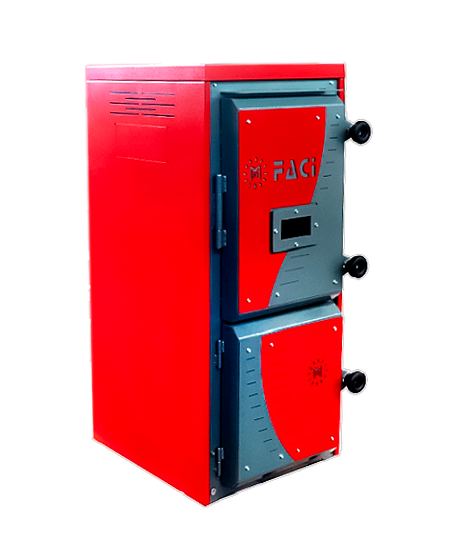
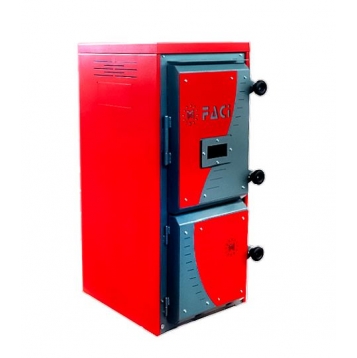
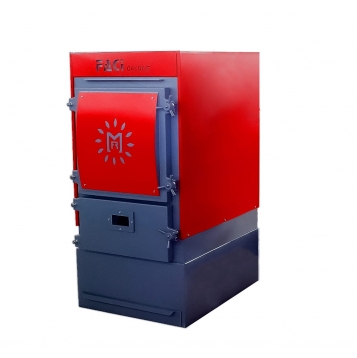
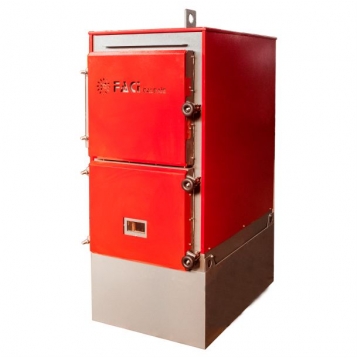
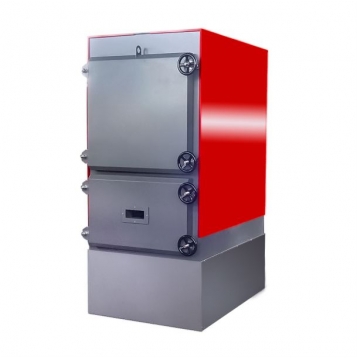
FACI TT 34 solid fuel boiler

🧮Calculate heating costs
pellets vs diesel, gas and electricity · boiler model selection
Maximum burning time
Removable grates
Convenient ash removal recess
Maximum heat transfer, high efficiency
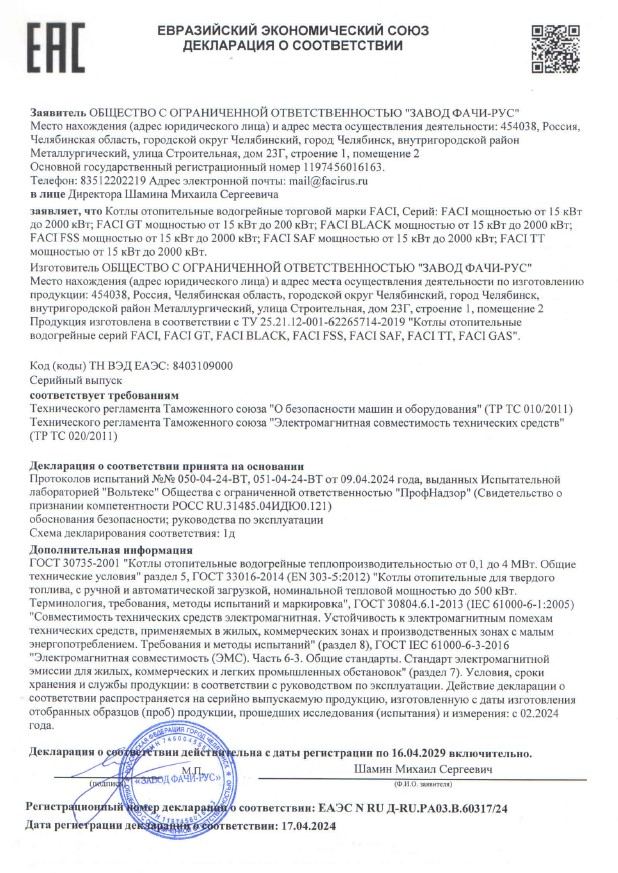
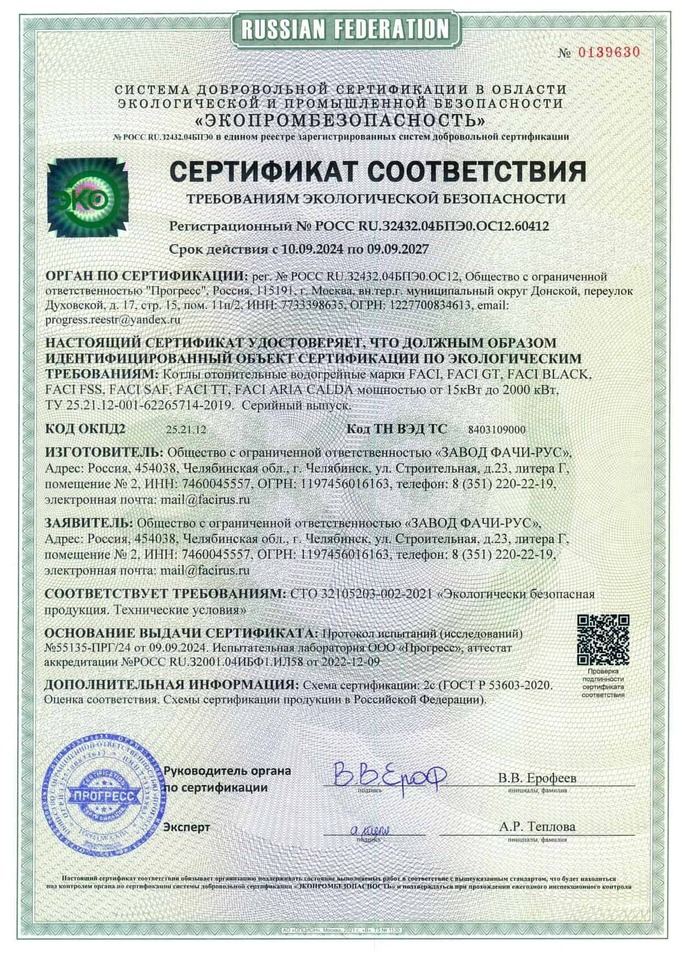
EAC Declaration of Conformity
Specifications:
  • Output34 kW
  • Fuel typeFirewood, coal, briquettes
  • Flue diameter160 mm
  • Weight230 kg
Fuel types:
Choose a configuration:
The package includes:
No additional options
Price:
194 880 ₽
174 000 ₽
Get a commercial proposal

Boiler description:

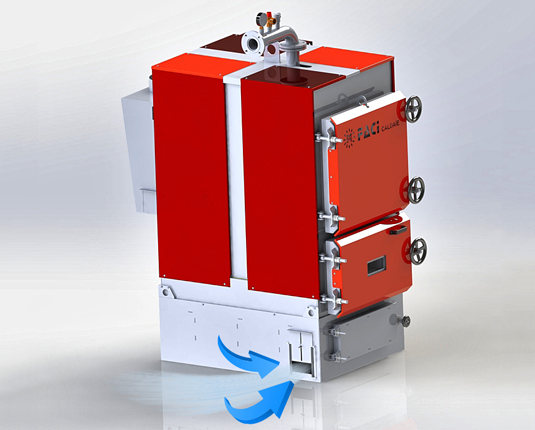
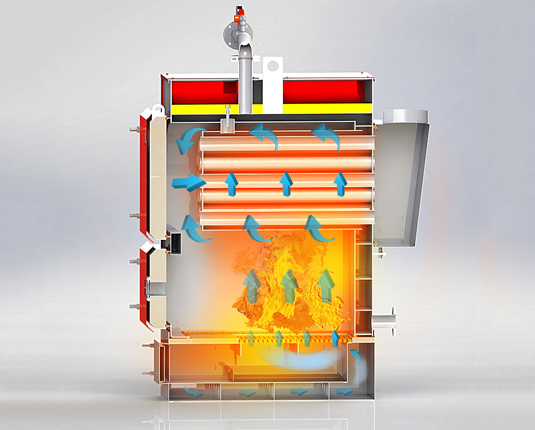
Optimal air supply

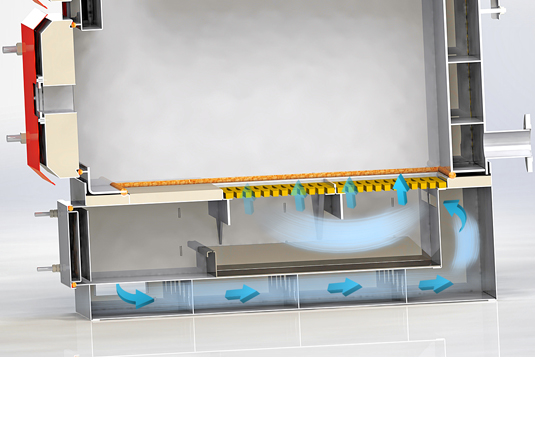
The air flow in the FACI solid fuel boiler follows a unique technology that achieves optimal air supply to the boiler without automation.

The air mixture enters the boiler through an adjustable damper on the right or left side.

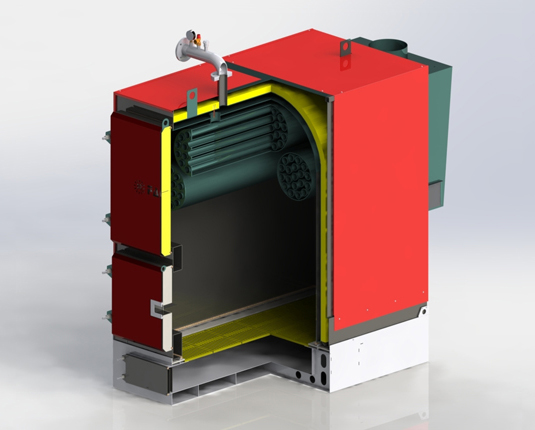
Huge loading chamber

The air mixture then passes through the air duct and perforated baffles, along the rear wall of the boiler and out through openings in the ash box.

A huge loading chamber is an important advantage of FACI TT boilers.

Look at the boiler dimensions and compare them with boilers of similar output offered to you — and it will immediately become clear where truly long burning is.

Truly long burning and removable grates

The air then passes through the grate and sustains combustion of the fuel at the very centre of the boiler — under the heat exchanger.
This achieves efficient and truly long burning.

In the FACI TT we use removable grates. We do not make the grates part of the heat exchanger (water-filled), because if they burn out, what would you do — replace the boiler? We offer to replace only the grates.  

Horizontal heat exchanger

Traditional for FACI boilers drum-type fire-tube heat exchanger.

Horizontal heat exchangers are the signature feature of FACI boilers. The boilers are designed so that the flue gases from the burnt fuel repeatedly pass AROUND the cylindrical heat exchanger.

This makes it possible to achieve maximum heat recovery from the flue gases and high efficiency.

And by installing turbulators you can increase efficiency by a further 5-7%!


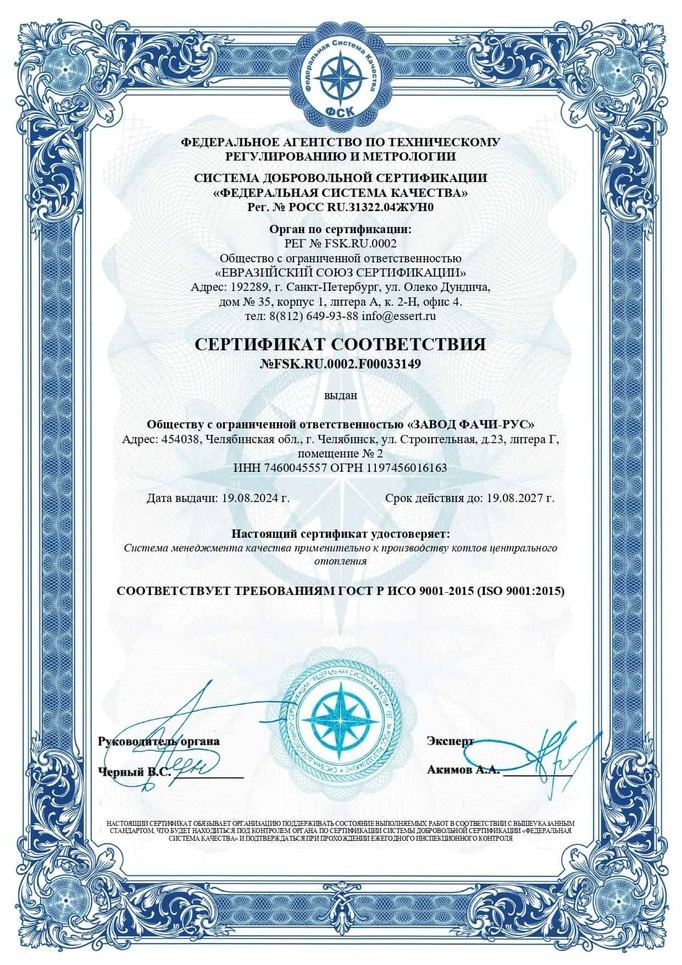
Certificates

Where solid fuel heating boilers are used

Solid fuel heating boilers are units that generate heat by burning firewood, hard coal, peat, coke, briquettes or pellets. They are used both to heat large industrial spaces and to heat private houses, cottages and other small buildings. They are a good alternative to gas boilers, whose fuel is not available in every region and town. These are very reliable units with long burning times and very high heat output — and solid fuel boilers are reasonably priced. The FACI TT series of solid fuel units has its own advantages.
  1. Optimal air flow. Air moves through the solid fuel boiler using a unique technology that achieves ideal velocity without automation. Air enters the unit through an adjustable damper on the right or left side.
  2. A very spacious loading chamber — one of the main advantages of TT boilers.
  3. Strong, reliable, wear-resistant removable grates. They are not part of the heat exchanger and are therefore not water-filled. This means a burnt-out grate can be replaced whenever the owner needs to. Anyone can install new grates, even without relevant experience.
  4. Horizontal heat exchanger of drum fire-tube type. The developer considers this technology its signature and readily promotes it along with other innovations.
Note that the boilers have a special design that passes the flue gases repeatedly through the cylindrical heat exchanger. All these innovations help achieve:
  • maximum heat transfer;
  • very high efficiency;
  • stable performance.

Boiler room arrangement

The specifics of operating solid fuel boilers mean that a boiler room and fuel storage area must be provided in advance. Wood and coal boilers must be placed in a separate, properly arranged room. This is the key to safe operation. Main boiler room requirements:
  1. Minimum boiler room area — 8 m², with a volume of at least 15 m³.
  2. Floor-to-ceiling height — at least 2.5 m.
  3. The heating boiler should be installed against a wall on a separate solid heat-resistant base at least 100 mm thick.
  4. The distance from the front of the boiler to the opposite wall must be at least the length of the boiler body to allow cleaning 
  5. The room must have at least one window whose area is proportional to the total volume of the room.
  6. The boiler room door must be made of fire-resistant metal and must open outwards.
  7. In addition to natural ventilation through windows and doors, forced ventilation is also required. The system is designed based on the equipment output.
  8. Keep the boiler room tidy, do not clutter it or use it to store unnecessary items, especially flammable ones.
  9. It is highly undesirable to place the boiler room inside the living space of the house. Ideally, use an annex or a free-standing building. In this case the boiler room is connected to the living area by safely enclosed and insulated utility lines.
The boiler room must accommodate all the necessary heating system elements:
  1. Solid fuel boiler;
  2. Heat exchanger;
  3. Distribution manifold;
  4. Boiler automation and control system;
  5. Complete piping for the equipment (pumps, dirt separators, pipework, expansion tanks, air ducts, etc.).
  6. Fire safety equipment (fire extinguisher, fire blanket, sand).

Energy classes of solid fuel heating boilers

Under the energy labelling directive for boilers and water heaters, the key value for labelling is the "seasonal space heating energy efficiency of the heater", calculated by the formula: ns = 0,85n1 + 0,15n4 - ∑F(i),   where: ns – seasonal energy efficiency of the equipment, %; n1 – useful efficiency at 30% of rated heat output, %; n4 – useful efficiency at rated heat output, %; F(i) – a correction factor accounting for auxiliary electricity consumption or standby losses. Energy efficiency data must be stated in the technical documentation and labelled with the letters A, B, C, D, E, F, G and a colour marker. The most energy-efficient units are labelled class "A", always on a green background. Boiler models with high fuel consumption are marked in red. Correspondence of energy efficiency class to the seasonal energy efficiency of heating equipment:
Energy efficiency class Seasonal efficiency value ns, %
A+++ ns ≥ 150 
A++ 125 ≤ ns < 150
A+ 98 ≤ ns < 125
A 90 ≤ ns < 98
B 82 ≤ ns < 90
C 75 ≤ ns < 82
D 36 ≤ ns < 75
E 34 ≤ ns < 36
F 30 ≤ ns < 34
G ns < 30
 

Key features of manual heating

A manually loaded solid fuel boiler works independently of other energy sources and can run on any cheap fuel. This makes it indispensable in the most remote areas without access to gas or electricity. Its service life can reach 50 years. However, manually loaded boilers cannot operate autonomously. They need constant supervision, monitoring of the fuel supply and periodic manual loading, as well as regular removal of combustion residues. Compared with other types of heating boilers, their combustion efficiency is noticeably lower, and low-quality fuel reduces overall efficiency further.